Waxing has come a long way as it should because all beauty products and services are quickly changing and evolving into better versions. The days of sticky strips, terrible adverse reactions, brittle hard wax and let’s not forget the awkward small talk are moving on to better products and improved techniques. Today, the world of waxing is split right down the middle, and it’s not about technique or tools—it’s about the experience.
Are you Team “In-and-Out in 15 Minutes or Less” or Team “Light a Candle and Let’s Learn Skin Rituals?” Welcome to the battle of the beauty trends of 2025: Speed Waxing vs. Spa-Like Waxing.
Both are hot topics. Both are in high demand. Both are reshaping how clients and professional think about the meaning of hair removal in 2025. With that being said, which one are you?
Speed Waxing: Quick, Clean, and To-the-Point
Let’s start with the fast lane because this has been in my opinion, rising so fast that it almost feels like if you can’t do it quick, you shouldn’t do it all.
Speed waxing is all about efficiency. Clients who choose this route aren’t here for fluff—they’re here to just get the job done. They want to get in, get smooth, and get on with their day, preferably before their parking expires or their lunchbreak is over. Caronlab can assist wax techs to make this possible for their clients.
Why it’s trending:
We’re busier than ever. Life doesn’t stop, and neither should your waxing schedule. We are always on the go and we don’t have a minute to lose nowadays!
Gen Z and millennials are all about convenience with quality.
Express waxing bars and tech-savvy booking systems are booming in urban hubs.
What it looks like:
A Brazilian in under 15 minutes or less? Yes, please.
Quick lunch break touch-ups—lip, chin, brows—literally done and dusted.
Membership models that reward frequent and fast visits. We want to see at least 20 bookings in a day otherwise we aren’t fast nor efficient enough.
What’s great about this:
High-volume = profits quickly
Appeals to grooming-focused clients who want regular upkeep.
No small talk required – just get to the point.
What to consider:
Less time for personal connection or education for your clients.
Not ideal for first-timers or nervous clients.
Your technique and wax choice need to be on point—speed without skills or a pattern or quality wax won’t cut it.
The Spa Waxing Experience: Rituals, Relaxation, and Real Connection
It’s time to slow things down – which I personally feel, is still a valuable option. Why are we always in such a rush? Why can’t I have some time for myself to feel pampered and cared for? Why not make every minute mean something?
On the flip side of the speed waxing world is a trend that embraces luxurious self-care. Spa-like waxing is no longer just about hair removal—it’s about creating a safe, comfortable space where your client can fully relax, unwind, and feel taken care of from start to finish.
Caronlab is fantastic for this because it takes it one step further to also make sure we maintainmodesty and comfort at all times.We make sure our client does as little as possible so they can relax and we do the work. This doesn’t mean we don’t require their assistance from time to time, it means we require the client’s assistance minimally.
Why it’s trending:
May people are craving slow beauty and mindfulness after years of burnout.
Clients want to feel seen and supported, not rushed in and out of their service because you have another client lined up back-to-back with no room to breathe.
The rise of trauma-informed and inclusive esthetics is changing the vibe.
What it looks like:
Customized pre- and post-care routines tailored to your client’s skin type and cycle.
Creating ambiance with soft lighting, calming music, and aromatherapy in the treatment room.
Informed conversations about skin, regrowth, and aftercare. It’s your chance to really connect and build meaningful relationships with your clients that helps to build trust and loyalty.
What’s great about this:
Higher price points with less rush. You may see less clients in a day, but you also see less burnout for yourself as the professional as well. Less space available to book means it creates a demand so your clients must rebook or fear losing their preferred appointment slot.
Clients stick around longer since you’ve built a meaningful relationship, they feel they get their money’s worth and want to rebook more often for the experience.
Perfect for first-timers and anxious clients – but also great for beginner wax technicians who are just getting into the waxing game.
You are able to suggest other services and home-care to benefit the client
What to consider:
Services take more time—fewer clients per day so make sure you charge accordingly for your time and product use. It’s also easier to suggest and perform additional services on a client during their original appointment.
Requires deeper knowledge and perhaps even advanced education of skincare, ingredients, and client communication.
Branding must clearly convey the elevated experience to differentiate yourself in the waxing market.
The Verdict
Okay Chanel… So, which one is better? Honestly? Neither.
It all comes down to who your clients are and what they value. Some want a no-nonsense, polished Brazilian right before their vacation. Others want to treat their wax appointment like a mini spa day since that may be the only hour they have for some relaxation. Some want both—depending on the moment. Being able to cater to both instances will benefit your business.
If your client ends up being late or can only give you 15 minutes of their time, the price doesn’t change since they are booking you for thetimeyou gave them – this needs to be communicated clearly. Take the extra time to give yourself a lunchbreak if you haven’t already, do some clean up, follow up on some other parts of your business that needs attending to, or just give yourself a moment to enjoy the luxury of having some time for yourself.
Waxing is no longer just about what you remove—it’s about what you create. Whether you deliver silky-smooth results in 15 minutes or less or turn your treatment room into a full-blown sanctuary, the power is in the experience.
So, are you Team Speed or Team Spa? Or maybe a little of both? Are you also teamCaronlab Waxperience?
Whatever your style, make it intentional, make it professional, and most of all—make it youand market the heck out of it!
In my previous blog, I touched on some controversial topics, and now I want to dive into another hot-button issue: soft wax. It’s a topic that’s been surrounded by debate and finger-pointing, with many proclaiming hard wax as the superior choice.
Reflecting on my own journey, I started my career 13 years ago, mainly learning the ins and outs of soft wax. My exposure to hard wax was limited, and I didn’t get enough practice to truly master it let alone fully understand it. During my esthetics training, I witnessed some of the soft waxing disasters that make even seasoned pros cringe—skin lifts, burns, and bruises galore. Despite my efficiency with soft wax that my instructors praised me on, these horror stories I heard and witnessed made me question if waxing the whole body with soft wax was right for me.
After graduation, I experimented with various wax brands from that era, even dabbling with sugar as a substitute for soft wax. I quickly discovered that while soft wax was cost-effective, the potential risks I knew of made me wary. I turned to hard wax, knowing it was generally considered safer, albeit at a higher price. My journey and discovery for hard waxes is a blog for another day.
It took me years to overcome my initial fears about soft wax. The root of my anxiety wasn’t the wax itself but my lack of education. I wasn’t taught the nuances of wax composition or the differences beyond what the labels claimed. I remember my final waxing exam was for a bikini, which unexpectedly turned into a Brazilian. We hadn’t been trained for Brazilian waxing, and I was the only one of my classmates required to perform one. How fair was that? Scoring only 70% felt like a crushing defeat, especially since I had excelled in all the other areas and I am also a notorious perfectionist. My instructor praised my technique but noted that my nervousness had affected my score. That experience has been implanted in my brain to this day and my decision to avoid Brazilian waxing with soft wax in the future.
Well, that was until I came across Caronlab.
WHY DOES SOFT WAX GET SUCH A BAD RAP TODAY?
It might sound like I’m downplaying soft wax, but that’s definitely not my intention in this blog. In fact, I always stock 2 strip waxes, 1 natural and 1 synthetic resin wax from Caronlab and decide on which wax to use based on the client and area to be waxed. With the knowledge I’ve gained, I now understand the full spectrum of waxing options. While soft wax can be highly effective and cost-efficient, especially for beginners, its reputation suffers due to potential adverse reactions and improper use or as I like to call it, “the horrors of waxing!”
Soft wax is often criticized because, in certain areas, professionals might wonder, “Where did I go wrong?” It’s not always about the wax itself but rather about whether it’s the right choice for the area you’re treating. Maybe your prep wasn’t quite right, but don’t jump to the conclusion that pre-oil is the magic fix. The need for pre-oil actually depends on the type of resin in your wax. In some cases, applying pre-oil can actually reduce the effectiveness of the wax. So, rather than relying on pre-oil as a one-size-fits-all solution, it’s important to understand how it interacts with your specific wax formula. It could even be down to poor technique, application and removal. Waxing technology is advancing rapidly, and there are now safer alternatives that function similarly to soft wax without the drawbacks.
Ultimately, the choice of wax is personal and should align with your ‘waxdentity’—the waxing style that best suits you and your clients. As I always say in every post, every class, and every student I come across with, “you do you.” At Caronlab, we generally recommend avoiding soft wax for facial and intimate areas (except for specific spots like the bikini line and the top of the pubic mound for Brazilian waxing).
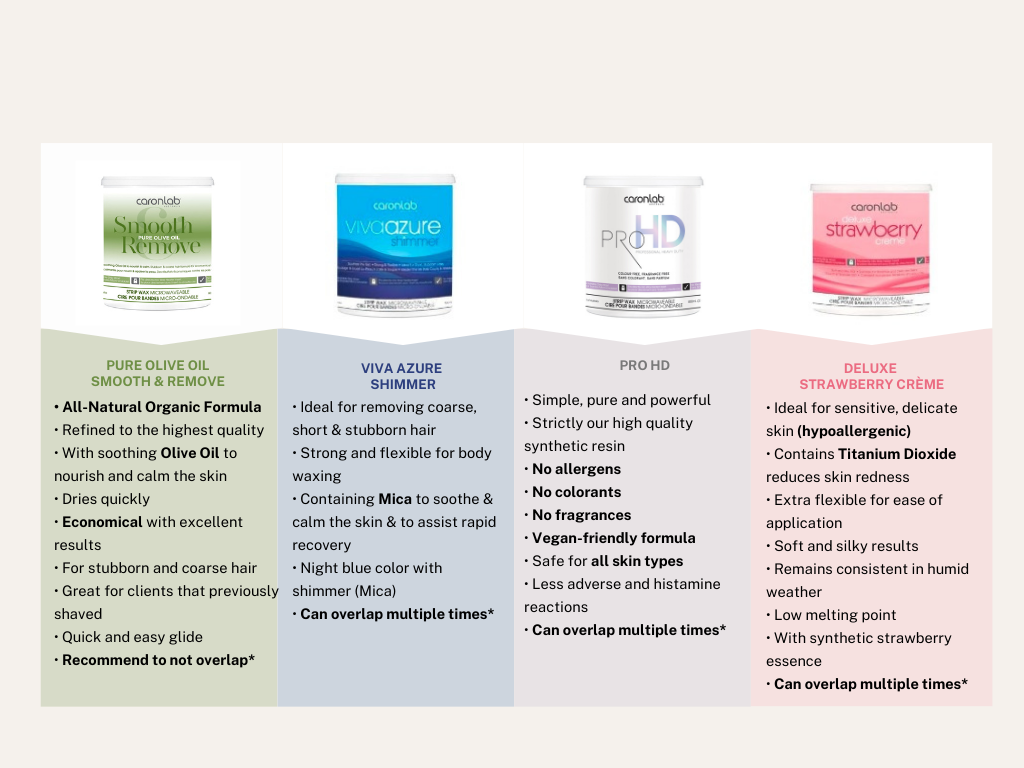
When tackling large areas, any soft wax from the Caronlab range will do the job. The choice depends on what you’re aiming for. The key thing to remember with Caronlab is that itrequires no pre-oil. In fact, using pre-oil can actually reduce the wax’s effectiveness in grabbing hairs. So, trust the wax and skip the pre-oil—it’s designed to work best on its own. To help you decide, I’ve outlined the benefits of each of our soft waxes in the chart below.
For those who still prefer using soft wax for facial and intimate areas, I recommend the Strawberry Crème Deluxe and Pro HD Strip. Both are synthetic resin-based, hypoallergenic, and exceptionally gentle on the skin. Personally, if I need to use soft wax on the face, I lean towards the cream-based options. They’re still quite grippy, but the key is to apply them ultra-thin—so thin that the skin underneath is almost visible. This technique ensures the best results and minimizes chances of adverse reactions. Ultimately, we highly recommend transitioning from your soft wax to Browvado Gel Sculpting Wax for all your facial waxing needs. It combines the gripping power of strip wax with the protective benefits of hard wax, offering the best of both worlds for a superior waxing experience.
THE VERDICT
The debate over whether soft wax or hard wax is superior is endless. Ultimately, it boils down to the professional and their ‘waxdentity’—the unique style and technique that suits them best. While certain products and waxes may offer distinct advantages, the key to delivering exceptional service is proper education and hands-on practice. No two professionals will provide the same experience, even with identical products and techniques.
If you choose to stick with soft wax, invest in the training and practice needed to perfect your skills. Conversely, if you find that you do need to incorporate hard wax—even if you believed soft wax was the only way for you—it’s okay, just welcome it and embrace it. The best approach is whatever works most effectively for you and your clients.
What other questions or topics do you want me to discuss in my next blog? Send a message or an email to let us know. Also, follow us on social media to know when my next post is available:
When I came across this question in the comments, I chuckled in my seat since I sensed this would come up someday. See, I do read your comments. Yes, I have heard of this technique and recently tested it to see what the hype is all about.
If you don’t know the “horseshoe method,” here’s a quick summary. It’s a Brazilian waxing technique where the wax is applied in a horseshoe or inverted U shape on both sides of the labia and the tip of the pubic mound above (or covering) the clitoris and removed in one big motion. It claims to be virtually painless and to tremendously cut down the service time.
I tried this approach on myself. I have always waxed myself when I am ovulating since I generally feel no discomfort during that time. I can finish my entire Brazilian in under ten minutes without issues and immense pain (unless I’ve left it for four or more months). I did this technique with four weeks of growth, and I felt like the pull was for four months of growth. It left me in tears.
My thoughts on this technique
I think this is a fascinating technique and would be great if you were in a pinch or if speed is what you promote for your business rather than client care and comfort. It would be excellent for a clean-up strip or someone who stays consistent with their wax appointments. I highly recommend that this is NOT performed on a first-time waxer or for someone with long, dense, or coarse hair. Think about this, we believe that if you applied wax on the ENTIRE vaginal anatomy, there would be no damage since it would just mould around the anatomy.
If you really want to use this technique, it would be much simpler with Caronlab hard waxes. Here’s an example of the outcome of my own Brazilian with the Brilliance Hard Wax. In this photo, I deliberately tried to glue myself shut. A fair warning: this was done for educational purposes; please do not do this on your clients.
Suppose you want the cleanest possible wax without fear of damaging anything. In that case, you can get yourself in as close as possible with any of the Caronlab hard waxes and overlap some of the anatomy to ensure the cleanest wax. You could combine “The Secret Garden” AND “The Butterfly” in one fell swoop, if that is a thing. But should you?
I shared the “horseshoe method” with my clientele, who told me they would run if I did this. Imagine how they reacted when I told them I attempted to glue myself shut – they were not completely surprised since they knew the depths I’d go to for research and education purposes. Their reactions to the “horseshoe method” gave me a good laugh because this technique doesn’t fall under my business model or how I want to run and promote my business. They appreciate the ‘Waxperience’ that I offer and that I AM a different waxer. I value their comfort more than how fast I can get them in and out the door.
THE VERDICT
There will be those who want to just rip the band-aid off once and call it a day, and then there are those who really care about not being rushed into something nerve-racking and sweat-building. You do you and choose whatever “waxdentity” you want to embrace for yourself and your business. Every day brings new product improvements and technique advancements, so why wouldn’t wax products and techniques change? There are enough clients in the world to fit every niche or general waxer and enough personalities to fit every professional.
What other question, topic or “myth” do you want me to discuss in my next blog? Send a message or an email to let us know. Also, follow us on social media to know when my next post is available:
Happy 2024, everyone! I hope 2024 serves as an amazing year for growth, opportunity, and positive energy for all of you and in all your endeavours.
I want to start off my 2024 blogs answering questions I have been asked from the last year. The blogs I write are all my opinions from one professional to another, with no right or wrong answers. In 2023, I hit many speed bumps trying to complete a blog. I had started several of them to address questions and concerns from many of you and never got around to finishing them. I would begin writing but couldn’t get what I hoped to convey on paper. 2023 was a pinnacle year for me that brought many changes in my professional career from the vast world of beauty. I was exposed to so many other beauty business professionals and felt I was always learning something or making new discoveries. I think it is time I finally put it down in writing and solidify some of these topics I’ve been wanting to cover.
I put “myths” in quotations for the title of this blog since when I get another professional asking me, “Have you heard of this?” or “Heard of that?” it almost makes it sound like something mysterious or something that needs to be discovered. Perhaps some of you are already aware of these “myths,” and some are dang curious if it is good or bad. In the following few blogs, I will discuss techniques and methods some of you have asked me about and briefly break them down.
NOSE WAXING
If you guys saw my last December webinar, I showcased a live demonstration of my beloved during a much overdue nose waxing. I used sticks to pick up wax and placed them inside his nostrils.
First Myth:The stick method removes ALL the hairs. This is the most bogus myth I keep hearing. Yes, you totally CAN remove every single hair in the nostril, but this is not what you are supposed to do. For women, we only remove the outer rim of the nose hairs and any hairs that are “sticking out” of the nose. Men generally like having the hairs removed a little bit deeper, and by a little bit, I literally mean millimetres worth. We aren’t shoving the whole stick into the nostril – we still need to leave some nose hairs since they serve a purpose. They act as a filtering system, so if you remove every hair, you’ve taken out the entire filtering system and leave clients at risk.
Second Myth:Nose waxing helps those with severe seasonal allergies. This statement is TRUE, and I have enough clients who suffer from seasonal allergies to clients who have to take a daily antihistamine. Think of it this way: nose hairs act as a filtering system. If there are too many particles or dander that get stuck in the nose, those who suffer from allergies will react and suffer from their allergies. My client, who takes a daily antihistamine, no longer requires them daily after getting regular nose waxes.
My mother, who needed a ton of convincing that nose waxing wasn’t painful, finally got hers done late last fall, which is the time she usually suffers the most. She was blown away by how she didn’t suffer as much with her allergies.
Third Myth: Nose waxing is painful. This is true if not done correctly but is totally false if the service is performed correctly. I always mention the importance of knowing how to properly do this quick and simple service so it is not painful. I refuse to do this service sitting up because of gravity. If you’re not using a dripless wax like Browvado, imagine how little wax catches the hair when your client sits up because gravity pulls the wax down. If possible, always have your client lying flat on their back to perform a nose waxing so no wax gets wasted. The right sticks used are also essential.
Never use cotton buds – the worst-case scenario is when the cotton unbinds itself from the stick and the wax gets stuck in your client’s nose.
Removal is super painful and so unnecessary. The trickiest part to get is right at the tip of the nose. I recommend browbeaters since they can get right into that small nook. I see people gripping nose bridges for removal – this does absolutely nothing. Imagine the painful bounce back if your wax is not fully set! The key is asking your client to breathe out of their mouth, grip their nose tightly and pull with conviction. After the pull, keep that pressure on the grip of the nose for a few extra seconds to help alleviate any sensation. It’s the same idea as waxing other areas, applying firm pressure after removal, and then slowly letting go. Remember to lightly oil with the After Oil solely on the outer rim of the nostrils for some hydration and the added antibacterial benefits of the tea tree oil. I recommend using a cotton bud since we lightly hydrate, not saturate the area with oil.
THE VERDICT
Do not fear doing and receiving a nose wax service. As long as you are attentive and perform the service correctly, it is an easy add-on to your services.
Stay tuned for the next article where I talk about a “myth” on Brazilian waxing methods.
If there is a different topic or question you would like me to cover, feel free to message or email us!
Also make sure you follow us on our social media, so you know when my next post is available:
The other day, it was brought to my attention that there are professionals promoting that there is no such thing as Sensitive Skin, only Reactive Skin. This is an awesome topic and I was going to let it just pass but the more I thought about what was said, the more I felt like I had to say something.
I am a little bit confused hearing the claim that there was no such thing as” sensitive skin” and that all skin is “reactive.” Since I am not just a waxer and my business is a solid split of 50% waxing and 50% facial skin therapy, it really made me wonder how this claim could have been made.
Why is the wax market so vast and the competition so high, if the wax you use does not matter if everyone is reactive? If that was the case, we only need one wax to do the job. So, in making this claim, then what is the reasoning behind the different types of waxes and what purpose do they even serve – am I right?
I understand, trying to decipher the differences is difficult to do just by a glance, and not everyone is aware that there are different types of skin to look for when we are combining waxing with facial skin therapy. This difficulty was apparent when I threw a poll up on my Instagram asking if you knew the difference. Those of you who do more than just waxing, like myself, understand the differences and know that there is Sensitive Skin vs Sensitized Skin vs Reactive Skin and then there are those who really do not know about these three skin types and are not sure how to decipher and deal with each one accordingly.
I am going to sum this up in the simplest way for you to understand the differences, what to take away, and how all this info relates to waxing in this video:
Key points to remember from my video:
Sensitive Skin is a skin type that is generally associated along with a skin condition (psoriasis, eczema, rosacea, local/contact dermatitis) and needs to be treated with extra care and caution.
Sensitized Skin is fixable once the compromised skin barrier is repaired. This usually happens when a client repeatedly damages their skin with harsh treatments or does not stick to a set skincare routine and constantly introduces new products and treatments to the skin.
Reactive Skin is the skins’ natural response to stimulus and/or trauma. This is a temporary skin condition resulting in some histamine reactions such as skin redness, irritation, and hives. These histamine reactions generally do not linger and will go away their own.
THE VERDICT
There are clear distinctions of different skin types and the fact that we have different options when it comes to wax. Which means each type of wax created does serve a purpose. I always mention how we take skincare and cosmetics ingredients into account but we also consider other factors such as “is this the right product for my client’s skin/skin type?” Why do we not do this when we are also picking the right wax? Waxing is still considered a treatment so why treat it any less than a facial?
Thanks to those who brought the post to my attention and wanted to pick my brain on the matter. This is my take on that comment and I hope this clarifies and helps you learn something new today. I hope this helps you know what kind of waxes and products you should be using for your clientele and not just relying heavily on “whatever is cheapest” and “whatever will get the job done” because there is so much more to waxing than just simply ripping out the hairs.
If there is a topic or question you would like me to cover, please feel free to message or email us!
Also make sure you follow us on our social media, so you know when my next post is available: