Waxing has come a long way as it should because all beauty products and services are quickly changing and evolving into better versions. The days of sticky strips, terrible adverse reactions, brittle hard wax and let’s not forget the awkward small talk are moving on to better products and improved techniques. Today, the world of waxing is split right down the middle, and it’s not about technique or tools—it’s about the experience.
Are you Team “In-and-Out in 15 Minutes or Less” or Team “Light a Candle and Let’s Learn Skin Rituals?” Welcome to the battle of the beauty trends of 2025: Speed Waxing vs. Spa-Like Waxing.
Both are hot topics. Both are in high demand. Both are reshaping how clients and professional think about the meaning of hair removal in 2025. With that being said, which one are you?
Speed Waxing: Quick, Clean, and To-the-Point
Let’s start with the fast lane because this has been in my opinion, rising so fast that it almost feels like if you can’t do it quick, you shouldn’t do it all.
Speed waxing is all about efficiency. Clients who choose this route aren’t here for fluff—they’re here to just get the job done. They want to get in, get smooth, and get on with their day, preferably before their parking expires or their lunchbreak is over. Caronlab can assist wax techs to make this possible for their clients.
Why it’s trending:
We’re busier than ever. Life doesn’t stop, and neither should your waxing schedule. We are always on the go and we don’t have a minute to lose nowadays!
Gen Z and millennials are all about convenience with quality.
Express waxing bars and tech-savvy booking systems are booming in urban hubs.
What it looks like:
A Brazilian in under 15 minutes or less? Yes, please.
Quick lunch break touch-ups—lip, chin, brows—literally done and dusted.
Membership models that reward frequent and fast visits. We want to see at least 20 bookings in a day otherwise we aren’t fast nor efficient enough.
What’s great about this:
High-volume = profits quickly
Appeals to grooming-focused clients who want regular upkeep.
No small talk required – just get to the point.
What to consider:
Less time for personal connection or education for your clients.
Not ideal for first-timers or nervous clients.
Your technique and wax choice need to be on point—speed without skills or a pattern or quality wax won’t cut it.
The Spa Waxing Experience: Rituals, Relaxation, and Real Connection
It’s time to slow things down – which I personally feel, is still a valuable option. Why are we always in such a rush? Why can’t I have some time for myself to feel pampered and cared for? Why not make every minute mean something?
On the flip side of the speed waxing world is a trend that embraces luxurious self-care. Spa-like waxing is no longer just about hair removal—it’s about creating a safe, comfortable space where your client can fully relax, unwind, and feel taken care of from start to finish.
Caronlab is fantastic for this because it takes it one step further to also make sure we maintainmodesty and comfort at all times.We make sure our client does as little as possible so they can relax and we do the work. This doesn’t mean we don’t require their assistance from time to time, it means we require the client’s assistance minimally.
Why it’s trending:
May people are craving slow beauty and mindfulness after years of burnout.
Clients want to feel seen and supported, not rushed in and out of their service because you have another client lined up back-to-back with no room to breathe.
The rise of trauma-informed and inclusive esthetics is changing the vibe.
What it looks like:
Customized pre- and post-care routines tailored to your client’s skin type and cycle.
Creating ambiance with soft lighting, calming music, and aromatherapy in the treatment room.
Informed conversations about skin, regrowth, and aftercare. It’s your chance to really connect and build meaningful relationships with your clients that helps to build trust and loyalty.
What’s great about this:
Higher price points with less rush. You may see less clients in a day, but you also see less burnout for yourself as the professional as well. Less space available to book means it creates a demand so your clients must rebook or fear losing their preferred appointment slot.
Clients stick around longer since you’ve built a meaningful relationship, they feel they get their money’s worth and want to rebook more often for the experience.
Perfect for first-timers and anxious clients – but also great for beginner wax technicians who are just getting into the waxing game.
You are able to suggest other services and home-care to benefit the client
What to consider:
Services take more time—fewer clients per day so make sure you charge accordingly for your time and product use. It’s also easier to suggest and perform additional services on a client during their original appointment.
Requires deeper knowledge and perhaps even advanced education of skincare, ingredients, and client communication.
Branding must clearly convey the elevated experience to differentiate yourself in the waxing market.
The Verdict
Okay Chanel… So, which one is better? Honestly? Neither.
It all comes down to who your clients are and what they value. Some want a no-nonsense, polished Brazilian right before their vacation. Others want to treat their wax appointment like a mini spa day since that may be the only hour they have for some relaxation. Some want both—depending on the moment. Being able to cater to both instances will benefit your business.
If your client ends up being late or can only give you 15 minutes of their time, the price doesn’t change since they are booking you for thetimeyou gave them – this needs to be communicated clearly. Take the extra time to give yourself a lunchbreak if you haven’t already, do some clean up, follow up on some other parts of your business that needs attending to, or just give yourself a moment to enjoy the luxury of having some time for yourself.
Waxing is no longer just about what you remove—it’s about what you create. Whether you deliver silky-smooth results in 15 minutes or less or turn your treatment room into a full-blown sanctuary, the power is in the experience.
So, are you Team Speed or Team Spa? Or maybe a little of both? Are you also teamCaronlab Waxperience?
Whatever your style, make it intentional, make it professional, and most of all—make it youand market the heck out of it!
In my previous blog, I touched on some controversial topics, and now I want to dive into another hot-button issue: soft wax. It’s a topic that’s been surrounded by debate and finger-pointing, with many proclaiming hard wax as the superior choice.
Reflecting on my own journey, I started my career 13 years ago, mainly learning the ins and outs of soft wax. My exposure to hard wax was limited, and I didn’t get enough practice to truly master it let alone fully understand it. During my esthetics training, I witnessed some of the soft waxing disasters that make even seasoned pros cringe—skin lifts, burns, and bruises galore. Despite my efficiency with soft wax that my instructors praised me on, these horror stories I heard and witnessed made me question if waxing the whole body with soft wax was right for me.
After graduation, I experimented with various wax brands from that era, even dabbling with sugar as a substitute for soft wax. I quickly discovered that while soft wax was cost-effective, the potential risks I knew of made me wary. I turned to hard wax, knowing it was generally considered safer, albeit at a higher price. My journey and discovery for hard waxes is a blog for another day.
It took me years to overcome my initial fears about soft wax. The root of my anxiety wasn’t the wax itself but my lack of education. I wasn’t taught the nuances of wax composition or the differences beyond what the labels claimed. I remember my final waxing exam was for a bikini, which unexpectedly turned into a Brazilian. We hadn’t been trained for Brazilian waxing, and I was the only one of my classmates required to perform one. How fair was that? Scoring only 70% felt like a crushing defeat, especially since I had excelled in all the other areas and I am also a notorious perfectionist. My instructor praised my technique but noted that my nervousness had affected my score. That experience has been implanted in my brain to this day and my decision to avoid Brazilian waxing with soft wax in the future.
Well, that was until I came across Caronlab.
WHY DOES SOFT WAX GET SUCH A BAD RAP TODAY?
It might sound like I’m downplaying soft wax, but that’s definitely not my intention in this blog. In fact, I always stock 2 strip waxes, 1 natural and 1 synthetic resin wax from Caronlab and decide on which wax to use based on the client and area to be waxed. With the knowledge I’ve gained, I now understand the full spectrum of waxing options. While soft wax can be highly effective and cost-efficient, especially for beginners, its reputation suffers due to potential adverse reactions and improper use or as I like to call it, “the horrors of waxing!”
Soft wax is often criticized because, in certain areas, professionals might wonder, “Where did I go wrong?” It’s not always about the wax itself but rather about whether it’s the right choice for the area you’re treating. Maybe your prep wasn’t quite right, but don’t jump to the conclusion that pre-oil is the magic fix. The need for pre-oil actually depends on the type of resin in your wax. In some cases, applying pre-oil can actually reduce the effectiveness of the wax. So, rather than relying on pre-oil as a one-size-fits-all solution, it’s important to understand how it interacts with your specific wax formula. It could even be down to poor technique, application and removal. Waxing technology is advancing rapidly, and there are now safer alternatives that function similarly to soft wax without the drawbacks.
Ultimately, the choice of wax is personal and should align with your ‘waxdentity’—the waxing style that best suits you and your clients. As I always say in every post, every class, and every student I come across with, “you do you.” At Caronlab, we generally recommend avoiding soft wax for facial and intimate areas (except for specific spots like the bikini line and the top of the pubic mound for Brazilian waxing).
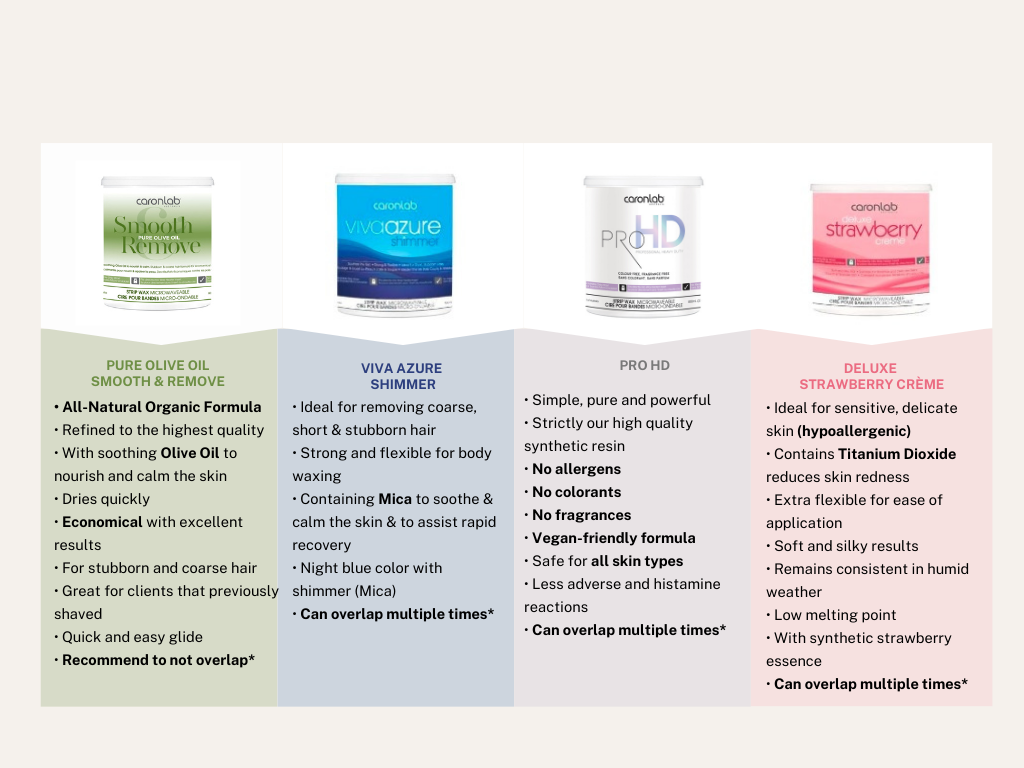
When tackling large areas, any soft wax from the Caronlab range will do the job. The choice depends on what you’re aiming for. The key thing to remember with Caronlab is that itrequires no pre-oil. In fact, using pre-oil can actually reduce the wax’s effectiveness in grabbing hairs. So, trust the wax and skip the pre-oil—it’s designed to work best on its own. To help you decide, I’ve outlined the benefits of each of our soft waxes in the chart below.
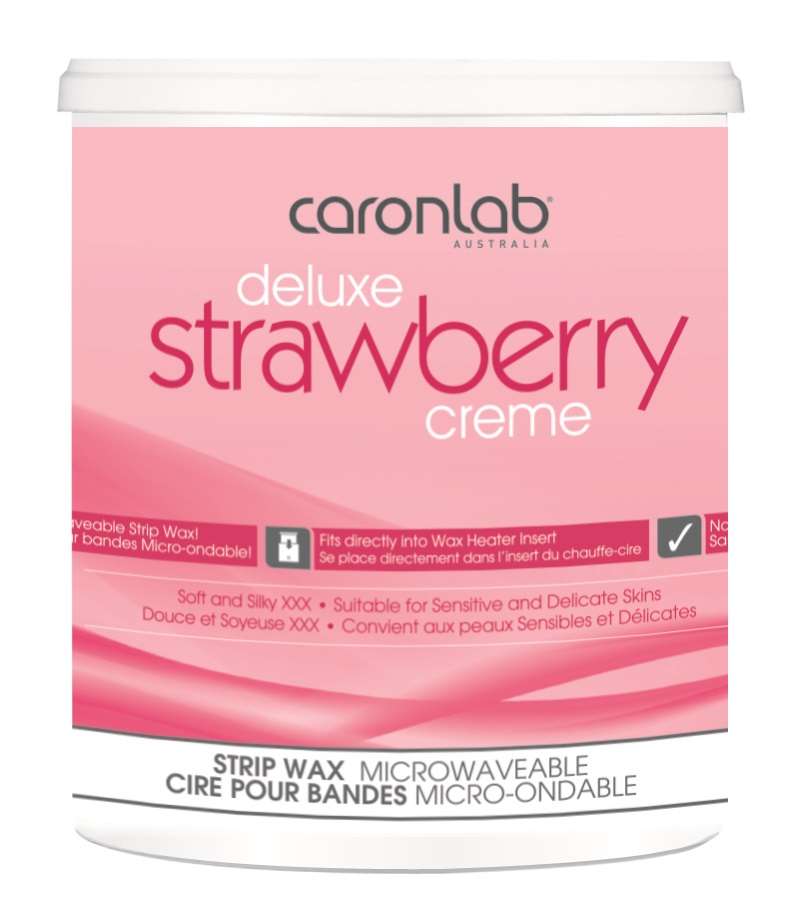
For those who still prefer using soft wax for facial and intimate areas, I recommend the Strawberry Crème Deluxe and Pro HD Strip. Both are synthetic resin-based, hypoallergenic, and exceptionally gentle on the skin. Personally, if I need to use soft wax on the face, I lean towards the cream-based options. They’re still quite grippy, but the key is to apply them ultra-thin—so thin that the skin underneath is almost visible. This technique ensures the best results and minimizes chances of adverse reactions. Ultimately, we highly recommend transitioning from your soft wax to Browvado Gel Sculpting Wax for all your facial waxing needs. It combines the gripping power of strip wax with the protective benefits of hard wax, offering the best of both worlds for a superior waxing experience.
THE VERDICT
The debate over whether soft wax or hard wax is superior is endless. Ultimately, it boils down to the professional and their ‘waxdentity’—the unique style and technique that suits them best. While certain products and waxes may offer distinct advantages, the key to delivering exceptional service is proper education and hands-on practice. No two professionals will provide the same experience, even with identical products and techniques.
If you choose to stick with soft wax, invest in the training and practice needed to perfect your skills. Conversely, if you find that you do need to incorporate hard wax—even if you believed soft wax was the only way for you—it’s okay, just welcome it and embrace it. The best approach is whatever works most effectively for you and your clients.
What other questions or topics do you want me to discuss in my next blog? Send a message or an email to let us know. Also, follow us on social media to know when my next post is available:
Hello everyone! Lately, I keep seeing professionals ask questions and talk about Brazilian waxing. It made me question several things in our industry and it prompted me to want to do this very raw blog for you since I feel like it must be said. But first, are you on the fence about offering this specialized service?
There seem to be the same reasons why a professional wonders about offering this specialized service:
Fear
Not finding the right wax
Cannot handle everyday bodily functions
Let’s break these down and explain how we can conquer (or not) the above points.
Fear of the “What if?” & Finding the Right Wax
Being afraid is normal. There is an uncertainty, that “what if?”What if I mess up? What if I do a bad job? What if I get nervous? What if my wax breaks? Well, what if I told you that a bit of practice and using the correct wax can take away all your “what if” fears?
Here is a short story about how I got into Brazilian waxing and how it is all thanks to Caronlab:
Caronlab has taken any of my uncertainty out of waxing or the need to second guess myself when performing a Brazilian waxing service. Lilliane Caron created signature techniques to perform the most intimate, gentle, and cleanest Brazilian that I have ever experienced. Did you know that she taught herself how to perform a Brazilian wax? She just knew that there had to be a better way, a better wax, a better experience for both the professional and the client. Hence, Brilliance Hard Wax was created.
If you’ve had a chance to see a Caronlab Brazilian demonstration or personally experienced one, you may be questioning a few things because it felt like we were breaking a lot of rules when it came to waxing. I also had some uncertainties at first because it wasn’t like the traditional Brazilian wax, but once I started practicing, it all made sense. It was a “try it to believe it” method and it made Brazilian waxing so much easier for me to perform on my clients as well as when I do my own waxing. My fear turned into confidence because I knew what my wax was able to do, and I knew how it was going to feel. Every time I do a Brazilian wax, it feels like I am practicing and honing my craft. I see new people, new anatomy shapes, new challenges – I am still constantly learning every single day when I walk into my space.
To those of you who are holding back because of fear, you can conquer your fear – use the right products especially picking up the right wax, practice, and never stop learning and honing your craft.
BODILY FUNCTIONS – EVERYDAY, NORMAL, HUMAN FUNCTIONS
I was really surprised with the number of topics I saw every week – there were at least 3 a week where people talked about bodily function. From bodily fluids to body odors to the “forbidden” erections. I put forbidden in italics since I actually do a big eye roll on this one. Let me break this one down first – the erections.
If you suspect your client is being inappropriate and is therefore producing an erection, there would’ve been many red flags from the start or even during the treatment. However, what if I told you majority of the time your client doesn’t even know that they are getting an erection? In fact, if you address it, I can guarantee your client will panic and be embarrassed and you will most likely lose this client. Did you know that baby boys get erections too? Does this mean it is sexual? HECK NO!
Reasons why an erection happens:
Warmth of the wax triggers a response.
Warmth of your hand stretching the skin for removal.
Waxing can stimulate blood flow.
This is the BEST time to take advantage of an erection and wax the shaft. The skin is stretched, and I will take this as an opportunity to get this area done before the erection wears off. Whenever my male clients do notice that their friend has sprung up, they get so apologetic. I simply just tell them, “It’s ok don’t worry, thank YOU because you just made my job easier!”
Bodily fluids; sweat, discharge, pre-ejaculate, period blood, feces, and urine. My biggest issue for writing this blog is the number of times I see professionals complain about feces when you work on the anus. It is a part of our job. Perhaps I have wiped enough baby bums to be desensitized, but literally sh** happens. I offer wipes before the service, and I ask my clients to use them before I return back to the treatment room. I’ve seen a lot of poop especially when I was working for a dermatologist and I was freshly out of school. Clean it up and get to work – this is a part of our profession. Client has their period? Either reschedule because they are probably going to be quite sensitive or provide them with a tampon and handle them with extra care. I’ve had clients mid-wax suddenly get their period – again, they were so apologetic. I wiped it up, handed her a tampon and got back to work. It is not our job to make our clients feel worse than they already do, we are there to uplift them and make them feel beautiful. So again, wipe it up and get back at it.
Body odor is the last one I see multiple times every week. I wear a mask in the treatment room, not to cover up body odors but it really can help to mask any smells. The client who comes straight from the gym, a client who has a pH unbalance, a client whose scent leaks out of the room (oh yes, I have definitely had this because my husband asked me what the smell was coming out of my room!) I personally feel like this comes with the job same with bodily fluids. Put some essential oils into a diffuser, wear a mask, spray down your room at clean up and get to work. Of course, if you suspect something is off from the smells, tell your clients they may want to consult their family doctor to see if there are any other underlying issues they may not be aware of. 9 times out of 10, they will thank you for going above and beyond for caring about their health and wellbeing.
THE VERDICT
If fear is what is holding you back, I can tell you from personal experience that it is definitely something that you can conquer. If you really cannot handle the everyday bodily fluids, odors and functions, then perhaps Brazilian waxing isn’t for you – AND THAT IS COMPLETELY OK!
I think someone who is forcing themselves to do something they cannot handle will not produce the best results or the best client Waxperience. Brazilian waxing takes a certain personality to be 100% comfortable of REALLY getting into the intimate areas. When I do a Brazilian wax, my hands are fully in there trying to spread and stretch the skin apart to get the cleanest wax. I have no problem gripping to stretch the shaft of a male client fully to ensure a safe removal of the wax and if he does get an erection, I continue working as if it hasn’t happened. At the end of the day, this is our profession, and you have to really love and own what you do. If something is holding you back, own it and tell yourself that it is OK because I am amazing at something else.
If there is a topic or question you would like me to cover, please feel free to message or email us!
Also make sure you follow us on our social media, so you know when my next post is available:
I received a question in one of my webinars asking me,“Isn’t paraffin wax a carcinogenic product?”
I didn’t want to just do a simple Instagram post addressing the question. Instead, I decided to do some digging around to learn more about paraffin and once again, I’ve done all the homework so you guys don’t have to so let’s get into Part 2 of The Ingredients – The Paraffin.
Question: “Is paraffin wax carcinogenic/toxic?”
Let’s back it up a little first – whenever we hear something is a “petroleum by-product” or “by-product of the fuel industry,” sirens go off in our heads that this sounds toxic. We put it on the “naughty list” of ingredients to avoid since some research suggests that if these particles were inhaled, they can be carcinogenic and cause potentially harmful effects to humans.Does it really though?
We need to understand that paraffin wax comes in many forms. The culprit that you want to stay away from are paraffin wax-based candles since it is mainly a raw hydrocarbon. A 2009 study that was conducted by researchers from South Carolina State University found that paraffin wax candles emitted unwanted chemicals due to it being a petroleum-based by-product. They would emit alkenes and toluene. Wait, hold up, what the heck are alkenes and toluene? These are aromatic hydrocarbons, which is why inhaling it is harmful. Think of paint thinners and how painters usually need to wear masks for protection so they aren’t breathing in the fumes.
These can be harmful to humans and contribute to the development of health risks such as cancer, allergies and even asthma. By now, you must be thinking that I have stated a lot of bad things about paraffin. So, why does Caronlab waxes have paraffin as an ingredient and what is done to assure it is safe?
Cosmeceutical Grade Paraffin Wax
There is nothing to worry about because all of those concerns listed abovedo not applyto paraffin waxes that you can find in cosmetic products and in our Caronlab waxes. The bad raw hydrocarbon has been processed to a “cosmetic-grade level,” meaning the risk for inhalation of the paraffin wax from beauty products are now minimal and there really is nothing to worry about anymore.
What I love about Caronlab is that it is a company that is 100% transparent. I have never come across a wax brand that would openly display online their Material Safety Data Sheets (MSDS) for every single one of their products. I went into every single one of our waxes to see which ones contain paraffin wax. All our synthetic resin-based waxes contain cosmetic grade paraffin wax. By now you must be thinking, “alright Chanel, thenwhydoes Caronlab waxes have paraffin wax in their formula andwhat purpose does it serve?”
My initial thought as to why paraffin is used in our waxes was because I was simply thinking about paraffin wax treatments that you can get a nail salon. In fact, I offer paraffin hand and foot treatments in my own space since it has many hydrating benefits and the heat really helps to soothe those with tired hands and/or those with arthritis. I thought, maybe it is used as a form of protection for the skin because our waxes do not require any pre-oil prior to performing a waxing service.
I sent Australia an email asking for some clarification and this is what I found out from their chemist: Paraffin can be used as a form of preservative which is why wax does not have an expiration date and a hydrogenating agent meaning it helps the wax to solidify and have some firmness. I went into our MSDS sheets. I found that, except for one, all of Caronlab waxes contained less than 10% paraffin. Our Braziliant 2 in 1 Film Wax has more than 10% but for no particular reason other than the paraffin’s compatibility with certain other constituents of the product.
IN CLOSING
There you have it in regard to paraffin. In summary, there is absolutely nothing to fear when it comes to paraffin wax as long as it has been processed to a cosmeceutical grade. Caronlab believes in a holistic concept and approach in the beauty industry that they call “Caronlab Cares.” Every detail, every ingredient, every product that Caronlab carries is meant to serve a specific purpose while taking the smallest details into consideration. We want safe options for everyone while trying to reduce our carbon footprint at the same time. Just knowing this gives me a warm, fuzzy feeling for Caronlab!
If there is a topic or question you would like me to cover, please feel free to message or email us!
Also make sure you follow us on our social media so you know when my next post is available:
I wanted to start the new year by diving into our resin. My hope is that in doing so I will answer some of your questions and help to debunk any misunderstandings some of you may have regarding our waxes. I do listen to your questions and your concerns, and I have gone ahead and done the homework, so you guys don’t have to.
Alright, so let’s back it up first – before Caronlab, I did not know a whole lot about wax ingredients let alone know what resin my wax was made of. I am sure a lot of you are the same way when it comes to picking a wax…price is always first and then maybe its scent and coloring that draws you in. When I came across Caronlab, I had zero knowledge of why it felt so good on the skin, why it hurt way less and why my skin seemed to react less than the other waxes I have used. It wasn’t until I started watching the Caronlab educational webinars that I began to understand why ingredients, especially the resin used in wax, are so important when it comes to hair removal. In today’s blog, I am going to share with you in detail about Caronlab’s synthetic hydrocarbon resin.
PINE RESIN
Before I talk about our resin, we need to talk about Natural Resin, also known as Pine Rosin or Colophonium. This can be found in majority of the waxes in the market because it is much cheaper to use in production. If it is cheaper to produce, then how much quality assurance do you think there is for each batch of wax that is made? To cut costs even further, the pine resin extracted from the trees are unrefined and therefore there is no product stability. Have you ever thought, “Wow this wax fragrance smells so heavily fragranced,” or “Look at this vibrant color!” I have thought these things and I was a sucker for beautiful colors! Well, the reason why some wax companies reason as to why you may have clients who are telling you that they cannot wax, why your clients may leave with excessive redness and histamine reactions, and why so many clients believe that waxing has to be super painful. To add insult to injury, colophonium is also the third highest cause of Occupational Asthma including itchy, runny eyes and fatigue.
Studies show that between 3.6% in Europe, 4.6% in the USA and up to 7% of people in Canada are all allergic to colophonium and these numbers are GROWING! Remember that natural is not always better. We get sucked into thinking natural is the best, but it really isn’t when it comes to hair removal. In fact, the more unnatural the better when it comes to waxing!
SYNTHETIC RESIN
Synthetic resins are going to be more consistent from batch to batch because it is a man-made substance. Synthetic resins are usually known as a hydrocarbon resin or polycyclopentadiene.
To spare some of you guys the scientific mumbo jumbo, if you want to hear me talk about polycyclopentadienes, then please feel free to play my quick 2 minute video explaining all of this:
I want you guys to understand when it comes to resins, Hydrocarbon resin is a safe product to use. Look at the ingredient concerns and where they rank in safety:
I took these stats off of a site that gave me ratings on how safe ingredients are considered. I’ve had clients tell me how they cannot wax, their skin gets super red, they get bumps and need to take an anti-histamine after a wax appointment. As you can see from the chart, a colophonium based wax may tick off a good amount of boxes, but allergies and immune-toxicity is considered moderate. Do we want something that could be moderately harmful for our clients? I think not!
Be aware that synthetic resins can also vary in quality and poor quality synthetic resins can pose the same amount of issues as with pine resin.
If you guys already know me, then you would know how much I love and refer to Brilliance Hard Wax “my baby!” So, what is the big deal about it and why am I head over heels for it? Brilliance Hard Wax is flexible, pliable, and moldable and won’t go brittle on you. Because it is made from a high-quality synthetic resin it is more consistent in production from batch to batch and it is easier and safer to work with. The waxes have a fresh and clean appearance. What a high quality synthetic resin should look like is a clear, translucent pale yellow. A pure white wax like Brilliance Hard Wax can only be created by the best synthetic resin available on the market and the reason why it is white is because of the added Titanium Oxide – that’s it. Nothing additional is in there to make it that creamy white color. At Caronlab, quality control is of utmost importance and is the key to creating a high quality and luxurious wax and that is why Brilliance Hard Wax is “my baby.”
THE VERDICT
The takeaway from all of this is to really understand what the main base ingredient your wax is made of and and what that means to you and your clients. I am telling you, switching over to Caronlab’s high quality synthetic resin waxes and using the Lilliane Caron signature techniques has made my clients happy and my job much easier. The most important thing to remember when it comes to hair removal, we are not trying to treat the skin but trying to remove the hairs. Let your pre and post ancillaries worry about being all natural and good for the skin. The wax should be as far from natural as possible.
Next month, I will be answering another ingredient question that I have received and it will be about paraffin wax. Why do we have it? What is the purpose? How does it differ from paraffin that is carcinogenic?
If there is a topic or question you would like me to cover, please feel free to message or email us!
Also make sure you follow us on our social media so you know when my next post is available:
I join many forums and groups for esthetics and waxing and every single day, there is at least one person who asks, “What is the best soft wax?” or “What is the best hard wax?” or “Hate my wax – give me your suggestions!” This is literally every single day, and the same answers always pile in. I sometimes feel like I need to advocate for Caronlab since I cannot believe people still do not know about this brand. I sometimes even see people mixing brands or waxes together to create the perfect wax to use. I honestly do not know how safe this is and why anyone would want to go through this kind of trouble when you could just pick the right wax from the start.
I started thinking just how little knowledge we have as technicians and professionals when it comes to choosing the right wax? The number one factor I always tend to see is price. I don’t know if it is positive to buy whatever is cheapest just to get the job done. I also see answers like, “The wax I want is too expensive, so I am going to settle for the cheaper stuff.” I’ve heard people say how much they love Caronlab but the moment they see the price tag they instantly decide not to buy the wax.
LET’S BREAK IT DOWN
I have a few accountant clients and they always say, “wax must be your biggest expense.” I explain that “actually disposable wax spatulas are my biggest expense.” I restock 2 large boxes of the big disposable wax spatulas bi-weekly and smaller spatulas in various sizes every few months. If you are still double dipping or flipping your spatulas around to use the other end to save a few dollars, STOP! If you want to use both ends of a single spatula, simply just snap them in half. Hygiene is important now more than ever since the global pandemic.
Let’s talk about resins briefly. If you are using a natural pine resin-based wax, I guarantee you that you will be spending more money in your wax room compared to your synthetic-based waxes. The majority of these waxes are usually in 397g/14oz tins with bright colours, heavily fragranced and super sticky. They are frustrating to work with because the hard wax will go brittle and will not perform the same from tin-to-tin and there is an increased chance of histamine reactions. Price point for this type of wax looks great because at first glance it appears that you have saved money because it is cheap. Except the reality is that you will have to stock more than one tin to last you the week and you will need to purchase more the week after. You want to make sure you are picking a high-qualitysynthetic resin-based wax to avoid all the problems mentioned with natural pine resin wax.
Our soft/strip waxes come in 800g/28oz recyclable plastic jars that are double the amount of wax that you can get from most other brands. A jar of 800g/29oz Caronlab wax appears costly upfront compared to a single 397g/14oz tin of strip wax. If you purchased 2 tins of the 397g/14oz wax it would actually cost MORE and you would be getting less than one jar of Caronlab strip wax! You will also need to use more of the poorer quality wax which also means you would have to purchase it more often, compared to Caronlab where you will be protecting the skin, removing the hairs, and using less wax.
Now what about hard wax? If you are purchasing 397g/14oz tins of hard, then your money is pretty much going down the drain. That natural resin wax is most likely brittle, your clients are getting histamine reactions and you’re using a lot of the wax to get the job done. Brilliance Hard Wax does come in a microwaveable formula and in an 800g recyclable plastic jar which looks more expensive, but the reality is that one jar of Brilliance costs less than 2 jars of your 397g/14oz natural resin tin and it also is easier to apply and remove and more comfortable for your clients.
Well, what about hard wax beads? A 5kg/11lb box of Braziliant Hard Wax Beads is going to be the best investment since you are buying the wax in bulk. Other brands using natural resin-based or a hybrid of natural/synthetic hard wax beads around the same size will seem like it would be better for your wallet but remember that natural resin waxes tend to go brittle. The wax also tends to be inconsistent from batch to batch and there is a higher chance of histamine reactions. The cost difference makes sense when using a high-quality synthetic-based resin wax because the waxes will be pliable, flexible, moldable and less painful during hair removal and the best for sensitive based skin types. Using a grippy wax like Braziliant 2 in 1 Film Wax means you will get the hairs the first time with minimal clean up and because you can apply the wax cellophane thin, you use less wax to get the job done and can expect to save money and not restock as often.
THE VERDICT
Is Caronlab really that expensive? It will be if you are not using the products properly! Application, wax consistency, and technique is so key to being how you can save money in the wax room. If you are going through the strip waxes quickly then I would revisit if you are applying the strip wax as close to transparent as possible. If you’re going through hard wax quickly, is the wax at the right temperature and consistency to grab the greatest number of hairs the first time?
I restock hard wax more since I mainly do Brazilian waxing services. I use a lot of Brilliance Hard Wax and I like to have my hard waxes always topped up. Soft wax requires a full top up bi-monthly for me. I have saved so much money making the switch over to Caronlab waxes and their concentrated ancillaries – you can save money in your wax room too!
Quoting Lilliane Caron in her October 4, 2018 blog: “Price should not defer you away from a high quality product. Paying that extra couple of dollars can make all the difference when it comes to securing repeat business and long-term clients. A salon providing high quality treatments, with high quality products can be extremely profitable. Cheap waxes cost more in the long run. The same goes if you are using more product to get the result, you actually have saved nothing and could ultimately lose the customer if you continually send them home with irritated skin and a substandard result. It all comes down to how many clients you have, and how many choose to come back to YOU over any other salon.”
If you have any questions, need help troubleshooting, want to know how you can start saving money in your wax room by switching to Caronlab, please feel free to message us! Let me know what you would like me to cover in my blogs and what you would like to see in our educational webinars!
Also, make sure you follow us on our social media so you know when my next post is available: