When I came across this question in the comments, I chuckled in my seat since I sensed this would come up someday. See, I do read your comments. Yes, I have heard of this technique and recently tested it to see what the hype is all about.
If you don’t know the “horseshoe method,” here’s a quick summary. It’s a Brazilian waxing technique where the wax is applied in a horseshoe or inverted U shape on both sides of the labia and the tip of the pubic mound above (or covering) the clitoris and removed in one big motion. It claims to be virtually painless and to tremendously cut down the service time.
I tried this approach on myself. I have always waxed myself when I am ovulating since I generally feel no discomfort during that time. I can finish my entire Brazilian in under ten minutes without issues and immense pain (unless I’ve left it for four or more months). I did this technique with four weeks of growth, and I felt like the pull was for four months of growth. It left me in tears.
My thoughts on this technique
I think this is a fascinating technique and would be great if you were in a pinch or if speed is what you promote for your business rather than client care and comfort. It would be excellent for a clean-up strip or someone who stays consistent with their wax appointments. I highly recommend that this is NOT performed on a first-time waxer or for someone with long, dense, or coarse hair. Think about this, we believe that if you applied wax on the ENTIRE vaginal anatomy, there would be no damage since it would just mould around the anatomy.
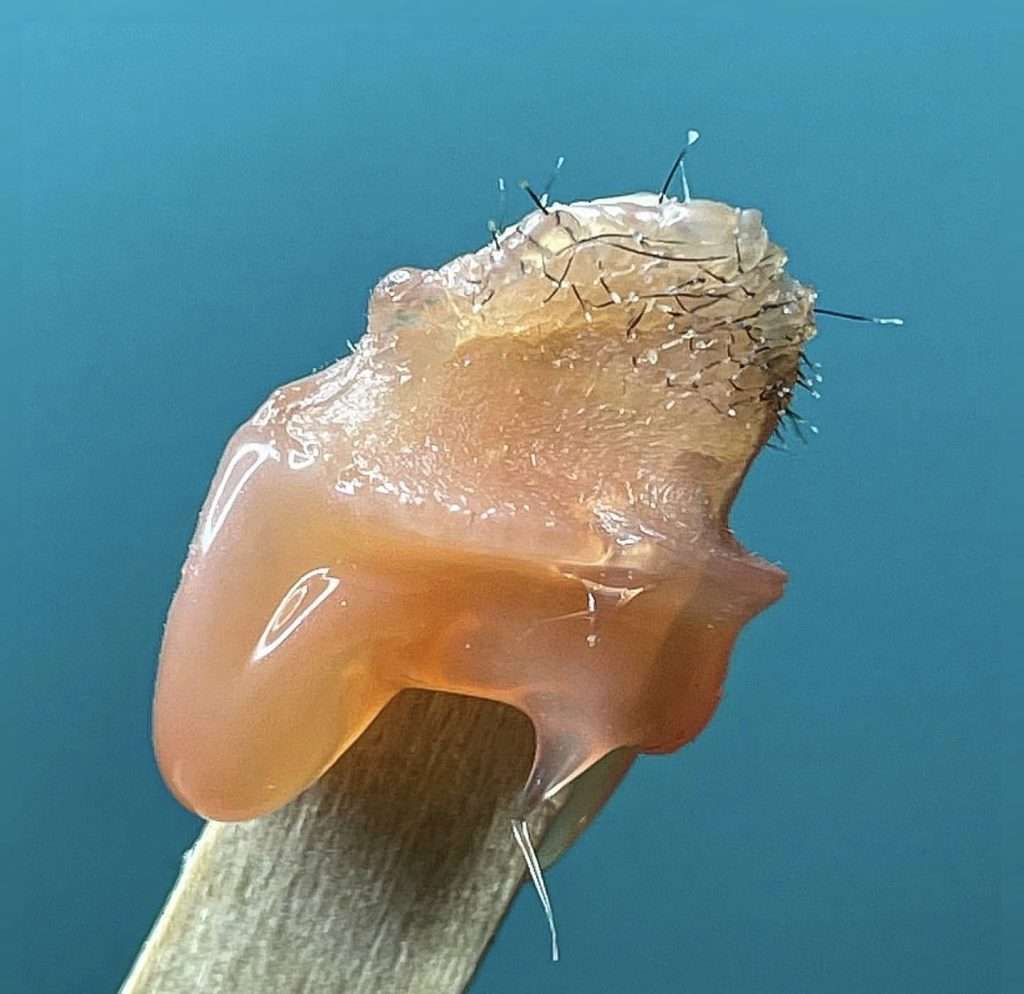
If you really want to use this technique, it would be much simpler with Caronlab hard waxes. Here’s an example of the outcome of my own Brazilian with the Brilliance Hard Wax. In this photo, I deliberately tried to glue myself shut. A fair warning: this was done for educational purposes; please do not do this on your clients.
Suppose you want the cleanest possible wax without fear of damaging anything. In that case, you can get yourself in as close as possible with any of the Caronlab hard waxes and overlap some of the anatomy to ensure the cleanest wax. You could combine “The Secret Garden” AND “The Butterfly” in one fell swoop, if that is a thing. But should you?
I shared the “horseshoe method” with my clientele, who told me they would run if I did this. Imagine how they reacted when I told them I attempted to glue myself shut – they were not completely surprised since they knew the depths I’d go to for research and education purposes. Their reactions to the “horseshoe method” gave me a good laugh because this technique doesn’t fall under my business model or how I want to run and promote my business. They appreciate the ‘Waxperience’ that I offer and that I AM a different waxer. I value their comfort more than how fast I can get them in and out the door.
THE VERDICT
There will be those who want to just rip the band-aid off once and call it a day, and then there are those who really care about not being rushed into something nerve-racking and sweat-building. You do you and choose whatever “waxdentity” you want to embrace for yourself and your business. Every day brings new product improvements and technique advancements, so why wouldn’t wax products and techniques change? There are enough clients in the world to fit every niche or general waxer and enough personalities to fit every professional.
What other question, topic or “myth” do you want me to discuss in my next blog? Send a message or an email to let us know. Also, follow us on social media to know when my next post is available:
Happy 2024, everyone! I hope 2024 serves as an amazing year for growth, opportunity, and positive energy for all of you and in all your endeavours.
I want to start off my 2024 blogs answering questions I have been asked from the last year. The blogs I write are all my opinions from one professional to another, with no right or wrong answers. In 2023, I hit many speed bumps trying to complete a blog. I had started several of them to address questions and concerns from many of you and never got around to finishing them. I would begin writing but couldn’t get what I hoped to convey on paper. 2023 was a pinnacle year for me that brought many changes in my professional career from the vast world of beauty. I was exposed to so many other beauty business professionals and felt I was always learning something or making new discoveries. I think it is time I finally put it down in writing and solidify some of these topics I’ve been wanting to cover.
I put “myths” in quotations for the title of this blog since when I get another professional asking me, “Have you heard of this?” or “Heard of that?” it almost makes it sound like something mysterious or something that needs to be discovered. Perhaps some of you are already aware of these “myths,” and some are dang curious if it is good or bad. In the following few blogs, I will discuss techniques and methods some of you have asked me about and briefly break them down.
NOSE WAXING
If you guys saw my last December webinar, I showcased a live demonstration of my beloved during a much overdue nose waxing. I used sticks to pick up wax and placed them inside his nostrils.
First Myth:The stick method removes ALL the hairs. This is the most bogus myth I keep hearing. Yes, you totally CAN remove every single hair in the nostril, but this is not what you are supposed to do. For women, we only remove the outer rim of the nose hairs and any hairs that are “sticking out” of the nose. Men generally like having the hairs removed a little bit deeper, and by a little bit, I literally mean millimetres worth. We aren’t shoving the whole stick into the nostril – we still need to leave some nose hairs since they serve a purpose. They act as a filtering system, so if you remove every hair, you’ve taken out the entire filtering system and leave clients at risk.
Second Myth:Nose waxing helps those with severe seasonal allergies. This statement is TRUE, and I have enough clients who suffer from seasonal allergies to clients who have to take a daily antihistamine. Think of it this way: nose hairs act as a filtering system. If there are too many particles or dander that get stuck in the nose, those who suffer from allergies will react and suffer from their allergies. My client, who takes a daily antihistamine, no longer requires them daily after getting regular nose waxes.
My mother, who needed a ton of convincing that nose waxing wasn’t painful, finally got hers done late last fall, which is the time she usually suffers the most. She was blown away by how she didn’t suffer as much with her allergies.
Third Myth: Nose waxing is painful. This is true if not done correctly but is totally false if the service is performed correctly. I always mention the importance of knowing how to properly do this quick and simple service so it is not painful. I refuse to do this service sitting up because of gravity. If you’re not using a dripless wax like Browvado, imagine how little wax catches the hair when your client sits up because gravity pulls the wax down. If possible, always have your client lying flat on their back to perform a nose waxing so no wax gets wasted. The right sticks used are also essential.
Never use cotton buds – the worst-case scenario is when the cotton unbinds itself from the stick and the wax gets stuck in your client’s nose.
Removal is super painful and so unnecessary. The trickiest part to get is right at the tip of the nose. I recommend browbeaters since they can get right into that small nook. I see people gripping nose bridges for removal – this does absolutely nothing. Imagine the painful bounce back if your wax is not fully set! The key is asking your client to breathe out of their mouth, grip their nose tightly and pull with conviction. After the pull, keep that pressure on the grip of the nose for a few extra seconds to help alleviate any sensation. It’s the same idea as waxing other areas, applying firm pressure after removal, and then slowly letting go. Remember to lightly oil with the After Oil solely on the outer rim of the nostrils for some hydration and the added antibacterial benefits of the tea tree oil. I recommend using a cotton bud since we lightly hydrate, not saturate the area with oil.
THE VERDICT
Do not fear doing and receiving a nose wax service. As long as you are attentive and perform the service correctly, it is an easy add-on to your services.
Stay tuned for the next article where I talk about a “myth” on Brazilian waxing methods.
If there is a different topic or question you would like me to cover, feel free to message or email us!
Also make sure you follow us on our social media, so you know when my next post is available:
The other day, it was brought to my attention that there are professionals promoting that there is no such thing as Sensitive Skin, only Reactive Skin. This is an awesome topic and I was going to let it just pass but the more I thought about what was said, the more I felt like I had to say something.
I am a little bit confused hearing the claim that there was no such thing as” sensitive skin” and that all skin is “reactive.” Since I am not just a waxer and my business is a solid split of 50% waxing and 50% facial skin therapy, it really made me wonder how this claim could have been made.
Why is the wax market so vast and the competition so high, if the wax you use does not matter if everyone is reactive? If that was the case, we only need one wax to do the job. So, in making this claim, then what is the reasoning behind the different types of waxes and what purpose do they even serve – am I right?
I understand, trying to decipher the differences is difficult to do just by a glance, and not everyone is aware that there are different types of skin to look for when we are combining waxing with facial skin therapy. This difficulty was apparent when I threw a poll up on my Instagram asking if you knew the difference. Those of you who do more than just waxing, like myself, understand the differences and know that there is Sensitive Skin vs Sensitized Skin vs Reactive Skin and then there are those who really do not know about these three skin types and are not sure how to decipher and deal with each one accordingly.
I am going to sum this up in the simplest way for you to understand the differences, what to take away, and how all this info relates to waxing in this video:
Key points to remember from my video:
Sensitive Skin is a skin type that is generally associated along with a skin condition (psoriasis, eczema, rosacea, local/contact dermatitis) and needs to be treated with extra care and caution.
Sensitized Skin is fixable once the compromised skin barrier is repaired. This usually happens when a client repeatedly damages their skin with harsh treatments or does not stick to a set skincare routine and constantly introduces new products and treatments to the skin.
Reactive Skin is the skins’ natural response to stimulus and/or trauma. This is a temporary skin condition resulting in some histamine reactions such as skin redness, irritation, and hives. These histamine reactions generally do not linger and will go away their own.
THE VERDICT
There are clear distinctions of different skin types and the fact that we have different options when it comes to wax. Which means each type of wax created does serve a purpose. I always mention how we take skincare and cosmetics ingredients into account but we also consider other factors such as “is this the right product for my client’s skin/skin type?” Why do we not do this when we are also picking the right wax? Waxing is still considered a treatment so why treat it any less than a facial?
Thanks to those who brought the post to my attention and wanted to pick my brain on the matter. This is my take on that comment and I hope this clarifies and helps you learn something new today. I hope this helps you know what kind of waxes and products you should be using for your clientele and not just relying heavily on “whatever is cheapest” and “whatever will get the job done” because there is so much more to waxing than just simply ripping out the hairs.
If there is a topic or question you would like me to cover, please feel free to message or email us!
Also make sure you follow us on our social media, so you know when my next post is available:
Lilliane Caron discusses hyperpigmentation and why it’s an avoidable and unacceptable side effect of waxing.
You may have read that waxing can cause darkening and darker skin patches called hyperpigmentation. The facts are, with superior product and expert technique, waxing won’t cause hyperpigmentation at all. Products or packages on offer that include serums claiming to reduce hyperpigmentation after waxing are essentially degrading to the wax industry. Skin damage due to waxing is unacceptable. A client shouldn’t leave a wax treatment feeling anything less than amazing, let alone loaded up with after-care products for an avoidable condition. Hyperpigmentation can occur after skin lifting, burning, irritation and bruising, all of which are completely unacceptable during the waxing process. Promoting a product/cure to treat an avoidable occurrence is simply lowering industry standards and that’s just not good enough for clients or our salons.
Hyperpigmentation occurs when excess melanin forms deposits under the lower layer of the epidermis and darker patches begin to appear. There are two types of hyperpigmentation, Passive Pigmentationand Post Inflammatory Hyperpigmentation (PIH).
Passive Pigmentation occurs when an internal imbalance stimulates our melanin producing hormones and generally occurs in women around times of hormonal changes such as puberty, pregnancy, contraceptive medication, and menopause.
Post Inflammatory Hyperpigmentation, is the result of skin trauma. When our skin is in distress, our melanocyte cell is stimulated to send melanin to the skin’s surface (between the dermis and the epidermis). Where waxing is concerned, the preventable trauma associated with hyperpigmentation occurs when the skin layers have been damaged due to lifting, burning, irritation and subsequent bruising. The occurrence of ingrown hair can be lessened during waxing when using the correct techniques. The scarring and darkening of the skin due to an infected ingrown is similar to acne scarring and can occur when the hair diverts while growing back through the surface of the skin.
Our products are best sellers because they are trusted to deliver a smooth and efficient Brazilian waxing treatment, without any side effects. Our kits offer every in-treatment product required delivering the entire service from pre-waxing hygiene, to post wax treatment and even room hygiene once the client has left the treatment. We’ve never considered wholesaling or retailing unnecessary after-care products because our waxes and pre & post products are superior and we care about your salon’s bottom line.
But it’s not just inferior products that are damaging the industry. Improper technique, speed waxing, 7 minute Brazilians, and the like are all grounds for skin trauma and un-happy clients. My article The Truth About The 7 Minute Brazilian goes into more detail about the importance of looking after our clients and taking the time to make sure we use gentle techniques.
Again, hyperpigmentation is an avoidable side effect so let’s talk about prevention…
Prevention is better than a cure
• Conducting a thorough skin analysis is imperative to getting to know your client’s requirements. Observations to consider include skin tone (darker tones are more prone to hyperpigmentation upon damage), the client’s age and any medications he/she may be using, as well as topical skin care products and ingredients. Each of these factors can determine skin health and elasticity and what wax treatments are most suitable. For all skin types, when waxing sensitive and intimate areas, we recommend Brilliance Hard Wax. It contains Titanium Dioxide to reduce skin redness.
A skin analysis is also a GREAT time to cross-promote your services. Whilst talking to the client on the condition of their skin you can upsell a suitable facial or body wrap to improve the health and appearance of their skin.
• Skin preparation is imperative to an effective and trauma-free wax. Micro Defence Foam is ideal for facial and intimate areas as it is an alcohol and chemical free biocide that eliminates germs, removes oils, surface dirt, moisture and makeup. Caronlab’s Pre Waxing Skin Cleanser is ideal for the body. Prepping the skin ensures that the area is clean and the wax grips the hair first time every time so no need to repeat waxing the same area which can lead to skin lifting.
• If you use an inferior product or you haven’t considered a suitable wax for your client’s skin type, it can lead to skin lifting, burning, pulling and bruising which as we know can lead to hyperpigmentation during the healing process.
When you’re assessing your wax ask yourself the following; does it grip the hairs? Is the consistency stringy? Does it smell of resin or chemicals? Does it lift the skin? Does it cause redness and irritation? Does it cause ingrown hairs or pimples? Does it require the use of a pre-wax oil to protect the skin? If you answered yes to one or more of these you definitely need to rethink your wax.
Consider a wax that is pliable, consistent, nourishing on the skin, has a subtle aroma, and of course, is removing hair properly. Brilliance the original white wax has been the number 1 selling wax in Australia for 10 years. If you are using a superior wax with a good reputation and still experience difficulty, it may be your technique. Don’t hesitate to ask the manufacturer. They can provide some tips on the best consistency and technique for using their wax. After all, they know it best!
• The number one most crucial step to avoid the horror of skin damage during waxing is technique. Training and up-to-date knowledge is imperative to protect your clients and your salon’s reputation. Caronlab provides extensive training and support through hands-on workshops. Keeping informed and up to date on the latest products and techniques is paramount to running a successful salon. Innovations in products can change the way our industry performs treatments. We’ve seen a huge rise in the use of fi lm wax since our Brazilliant beaded fi lm wax hit the market. This new product has a lower melting point, unique application and removal technique and can be used all over the body.
• Soothing with an after wax treatment can nourish and cool the skin. Caronlab’s After Care lotions with Mango and Witchazel or Tea Tree Oil, have pharmaceutical properties that actively soothe skin after waxing.
Another factor to consider post waxing is that during the natural process of waxing, dead skin cells are lifted revealing fresh new skin cells. These new cells may be more sensitive and reactive to UV light which is something to be aware of for hyperpigmentation prone clients. We recommend all skin types to wear protective clothing and a SPF 50+ to protect their skin after waxing and beyond.
• Following up with appropriate and affordable aftercare advice is a great way to protect the integrity of your treatment. Breakouts can occur after waxing the lip for the fi rst time, to avoid this use Bump eRaiser Medi Paste. Also as a preventative measure, the entire range of Bump eRaiser (Cool Splash, Triple Action Lotion, Zesty Wash, Exfoliating Mitt) can counteract the possibility of ingrown hair. As a retail option you can make a great profit on-selling this necessary range to your clients and in-turn they’ll be wrapped with the results.
As Therapists, it is our job to do all we can to make a client’s waxing experience, including the treatment itself and the results afterwards as pleasant as possible. Globally, salons and aestheticians have a healthy, booming waxing industry. With IPL becoming increasingly popular we need to protect our client base from scaremongering about avoidable side effects. And if clients suffer from severe side effects because we aren’t using the right products or technique – they definitely won’t be back!
Contact us today if you’re considering a re-fresh in your training and skill set. We’d be more than happy to come and teach you more about our latest products and how they can lead to repeat business and happy clients.
Lilliane Caron is Owner & Director of Caronlab Australia and Waxxxpress
There are milestones in every mother-daughter relationship and hair removal is one of them. Once upon a time most mothers wouldn’t have had to worry about this until puberty, but these days the conversation may start a little earlier than expected. If you asked me to put an age limit on when waxing became acceptable, I couldn’t. I believe that some girls are too young to be waxed, but I also believe there is an exception to every rule. The real question is what is our duty of care as Beauty Therapists in these kinds of situations?
Times are changing
The general notion is that girls may start to be interested in hair removal once they hit puberty and hair growth spikes, but that is not always the case. While most young girls experience a small amount of hair on their bodies, I have seen firsthand, girls as young as seven with excessive hair growth on their legs, arms and face. This can be related to cultural and genetic factors, however I believe it is also a result of our changing environment. Children are physically developing a lot earlier than years gone by due to what we are eating and using in our day to day lives. Foods are full of hormones and as a result, girls are getting their periods younger – which means entering womanhood and everything that comes with it is also happening sooner. When I began my career, women would generally start waxing when they were about 18 but in today’s society girls are growing up faster than ever before.
Social Influence
With social media being so prominent in our lives, children are being exposed to more and more things that would have once been beyond their years. Kids are seeing models and celebrities acting, dressing and looking a certain way, and of course want to mimic that look. It’s not just celebrities that are influencing today’s youth; their friends and families are playing a big role too. Kids as young as 10 years old have blogs, Instagram, Facebook and YouTube accounts. As adults, we can understand that most photos uploaded to social media are carefully styled, have filters applied and multiple photos were actually taken at slightly different angles, all for that ‘perfect’ shot. But young, susceptible minds don’t always understand this.
Not only are young girls being subjected to unrealistic body images but young boys are too. Early on, boys notice women being represented in a certain way – with flawless, hair-free, skin. Because of the portrayal of woman in the media, there is a stigma related to hair on the body. The ability to differentiate between women and girls is becoming blurry. Children at school are surrounded by others who all have their own thoughts on facial and body hair. Some are bullied and tormented for hair growth that is completely natural. Hair on our bodies is not a new revelation; it is a part of being a human. Children should never have to worry about this. As adults we spend far too much time criticising ourselves and our flaws and it’s upsetting to think that children are starting to do this from such a young age. With a whole new spotlight on hair removal and minors, we as therapists have to recognise and sympathise with this issue.
The Motive
We need to be able to spot the motive behind unwanted hair removal. If a child is being bullied or feels self-conscious about their body hair, I can completely understand the reason behind wanting to remove it. My concern is that children are simply jumping aboard the waxing train to be ‘cool’, not because they need to. When a child comes in with very little visible hair on their legs and without the supervision of an adult, this is where it gets tricky. In this type of situation I urge you to consider a few things. Does the child have extreme hair growth? Is the child suffering from bullying or peer pressure? Does the child participate in a sport or activity where it may be embarrassing for them to have hair showing? Swimming, gymnastics and dancing activities may require young girls to wear leotards or costumes that expose bikini, underarm and leg hair. It’s easy to see how this would be embarrassing for anyone, especially those lacking confidence as their body is changing. All these are important factors and I believe each individual needs to be looked at on a case by case manner.
Mother knows best
Most of the time the decision for a child to be waxed or not will come down to the mother – and some mothers want their children to start waxing early. Perhaps they have their own insecurities from when they were a child or perhaps they feel pressure to keep up with what the other mothers are doing. One mother may get her daughters eyebrows waxed, and she will tell another mother, and that mother will tell another, and then before you know it you have multiple children booked in who don’t even need their eyebrows waxed because the mothers think that it is a the normal thing to do. It can become a social norm in many circles. Mother’s competing with one another is becoming more and more apparent and no mother wants to feel like there child is getting left behind.
As a parent, your role is to identify issues, educate and guide your children along the right path. While it is not our place to judge any parent on these decisions, it is our place to be there as a guide for mothers and their daughters and offer them some advice and education about hair removal in particular. This goes for mothers who may be starting their daughters too early, or for mothers who are scared of letting their daughters start too young. Often mothers will call us in for backup; after all, who better to explain the hair removal process than us? Children don’t often realise that waxing requires regular maintenance and once they have started; they could be doing for the next 50 years. We need to highlight the bigger picture so they understand waxing is not just a once off thing, but a commitment they need to be ready to make.
Common Sense
I am a business woman, however when it comes to children I believe you need to set aside your business cap for just one moment. While we of course want to secure business, in these contentious cases we are dealing with young impressionable minds and it’s extremely important to remember that. Often my rule is that if I am standing two feet away and cannot see any hair, then in my opinion there is no hair that needs to be removed. It ultimately comes down to using your common sense. It is our right to say no if we don’t feel comfortable removing the hair, especially if the child is pre-pubescent or there is no guardian approval involved. You can always look at enforcing a policy for your salon such a ‘children under the age of 16 may not get waxed without parental consent.’ This way you and your staff are protected from any backlash you may receive from unaware parents.
The last thing any of us want are young girls sneaking around behind their parents backs or attempting shaving at home with no supervision or experience. At least if they are starting their hair removal routine with waxing, over time it will help to break down the hair follicle quicker and over time they will begin to notice less hair growth. Once they start, they should keep up with regular appointments. Generally with young clientele it is not necessary to wax every 4-6 weeks. Often every three or four months is sufficient – but again, this depends on the child’s hair growth.
If removing hair is going to make a someone feel better about themselves and give them the confidence to walk around happy, then I am all for it. Don’t forget that there is a slight discomfort involved with waxing, and some children simply do not have the pain threshold to cope with it, it often depends on their maturity levels. I would always use a hard wax for delicate areas such as face, bikini and underarms, and a creamy gentle strip wax for larger areas such as legs. Using a low temperature, high quality wax can help to reduce the pain associated with waxing. If you choose not to wax a minor, you could try to offer them a treatment other than waxing to boost their self-esteem, make them feel older and pampered. A mani or pedi, a facial or a massage is a lovely treat and could take their mind off wanting to wax.
Sugaring has been around for centuries and is an early form of waxing, however it has recently re-entered the beauty scene. While most therapists are well aware of sugaring and how long it has been around, Body Sugaring is becoming a popular request from clients.
So why, after centuries of flying under the radar and being outshone by waxing has sugaring started to make a comeback? These days’ consumers are looking for more natural alternatives for their food, skincare and cleaning products and are taking more notice of what we are putting on and in our bodies. Companies who only manufacture sugaring paste (no wax) have also made claims, such as ‘sugaring is less painful’, ‘sugaring doesn’t cause skin irritations’ and ‘sugaring provides longer lasting results’. They’ve put a spin on the technique to make it seem superior. While there are some very relevant advantages to sugaring, these claims are not all true. There is also a level of secrecy among many sugaring professionals which makes sugaring seem even more exclusive.
Firstly, let’s discuss what body sugaring actually is. The technique of sugaring uses a natural toffee-like substance that is kneaded into the skin repeatedly, removing the hair as it goes. The paste is spread or moulded onto the skin by hand or with a spatula against the direction of hair growth. It is said to seep down into the hair follicle and wrap itself around the shaft of the hair. When the sugaring paste is flicked off, the hair including the bulb slides out in the direction in which it grows. This technique differs to waxing which removes the hair in the opposite direction. One of my very first memories of hair removal is making my own sugar paste with my Lebanese friends and using it on each other! Back then sugaring was more common because you would actually make it yourself in a pot on the stove. How funny it is, that everything seems to work in a full circle!
While waxing and sugaring techniques are different, the results are much the same when performed correctly. Therapists who have been trained in waxing and decide to offer sugaring essentially need to “unlearn” everything they know about waxing to become a proficient body sugarer and perfect their technique.
Some clients will swear black and blue that sugaring hurts less than waxing, but just like any treatment it really comes down to the skill of the therapist. Both techniques remove hair from the follicle and that’s not going to tickle. They can however be substantially less painful if the therapist is performing the treatment with a good technique. For some clients, a bad wax from an inexperienced therapist can make a good sugaring treatment seem like the pinnacle of hair removal. Someone who has never experienced a good wax treatment won’t realise that waxing should be better, and unfortunately a bad experience can be enough to deter someone from waxing all together. Sugar addicts also claim that waxing can lead to more broken hairs, however without a proficient technique sugaring can too. If you are using your wax correctly; at the right temperature and not speed waxing, there should be no broken hairs in sight.
Anyone who has ever heard me talk about waxes, will know that the consistency of your wax is vital when it comes to delivering the perfect waxing treatment. Sugaring is no different. Sugaring paste is warmed only slightly, making it almost impossible to burn clients. The paste gains temperature through body heat and this can play a role in how it works. It can also work differently in warmer climates and spoil easily. It will crystallise if exposed to moisture – even the smallest amount of sanitising solution or water can affect the consistency and effectiveness of the product, and if it’s heated too much it will burn. A big advantage of sugaring is that generally only one ball of paste is required per body part, so there’s no going back and forth to the wax pot or risk of double dipping.
Sugaring pastes are available in different varieties. Firm pastes are ideal for beginners as they’re easier to control. They are designed to be used on warmer areas of the body like the Brazilian and underarm, are good for smaller areas of the body and for use in warmer climates. A soft paste is suited to a more experienced therapist and for use on larger areas such as legs and arms that normally aren’t as warm. I find using a sugar-based strip wax in conjunction with your sugaring paste can speed up the process of removing hair from the larger areas whilst still giving your clients an all-natural treatment.
Ingredients in waxes can vary greatly; they can be derived from unrefined resins (pine resin) or synthetic resins. There is much less room for variance when it comes to manufacturing sugaring pastes. Sugaring pastes or gels are essentially made from sugar, water and lemon juice. While all recipes are slightly different, it has been made from those same basic ingredients since it originated in the ancient Middle-Eastern practice centuries ago.
Because of the basic and natural formula, sugaring is gaining a high reputation for not causing skin irritations, which is backlash that waxing can sometimes cop. Sugaring can absolutely be a solution for clients that choose not to wax because they suffer from reactions and irritations from even the most sensitive waxes. However what bugs me about this perception of waxing is skin irritations are generally not normal. If clients are suffering from irritations, it usually comes down to the wax being used and the resins they contain.
If you’re considering adding body sugaring to your treatment menu, there are some important things for you to think about. Firstly, ask your clients if they are happy with their waxing treatments? If they’re not happy, delve into the reasons why. Are your therapists lacking confidence or expertise? Rather than re-training your staff in a skill they have already learnt, maybe they would benefit from a refresher waxing workshop. Getting their waxing skills up to scratch will be a lot easier, quicker and cost effective than learning an entirely new technique.
You need to determine if sugaring fits your business model. Some salons and spas base all of their offerings around natural, vegan friendly and organic products and services, and this can be a real point of difference. There will always be a niche client market wanting a holistic and completely natural treatment, and business savvy salons can reap the benefits of this. Salons offering this exclusive service will generally charge more than a waxing treatment as it does take more time to perform and while cost effective, the paste does cost more per kilo than most waxes. In saying this, clients seeking natural alternatives are generally willing to pay that little bit extra.
If you have a mobile business, sugaring can be a great option, especially if you’d like to specialise in it. It requires little to no heating, making travelling and setting up for appointments easy and one ball will generally get you through an entire treatment. As sugaring paste can simply be washed off with warm water, no extra product is necessary during the treatment or for cleaning-up. Clients can be turned over quickly and efficiently. Just remember to clean your mobile station regularly as ants LOVE sugar!
You should also keep in mind personal preference, it’s no secret that I favour waxing, I find sugaring more taxing on my wrists. But everyone is different, I know therapists who find sugaring to be much easier on their body, so it really does come down to what you like doing and how your body works.
While sugar paste will not necessarily replace your waxes, there may be a place for it alongside the waxes on your trolley. However if you’re simply looking to jump on the sugaring band wagon ‘just because’ I strongly urge you to re-consider.